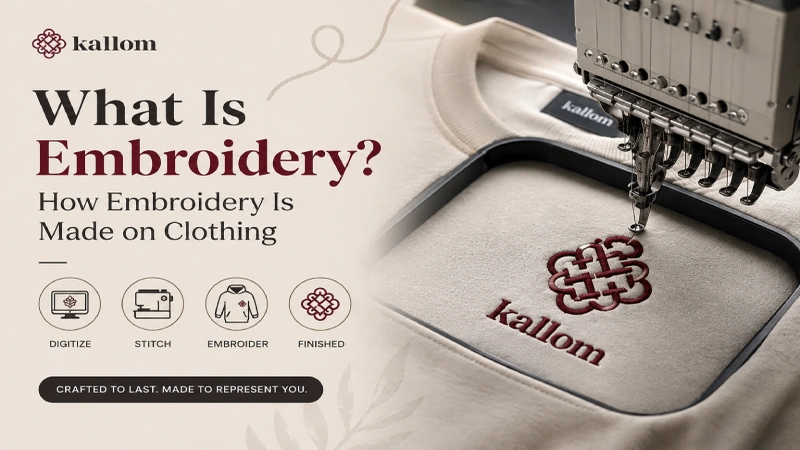
Embroidery is the craft of decorating fabric by stitching a design into it with needle and thread, either by hand or by machine. Because the thread is sewn into the material rather than printed on top, stitched designs keep their shape, colour and texture for years.
You will find embroidery on hoodies, polo shirts, caps, uniforms and even home textiles. This guide covers how it works, how it is made on clothing, the main stitch types, how it compares with printing, and how to look after it.
What Is Embroidery?
Embroidery means creating designs, text or images on fabric using thread. The word comes from the Old French embroderie, linked to the idea of embellishing something. The key point is that the thread passes through the fabric, so the design becomes part of the garment. That is why embroidery has a raised texture you can feel, while a print is a flat layer of ink.
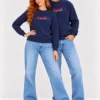
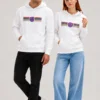
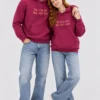
It's used across clothing, accessories, home textiles and even artwork but its most common modern use is on garments like hoodies, polo shirts, jackets and caps, where a name, initials, or a logo is added as a lasting, premium finish. See it up close on our own pieces: Custom Embroidered Hoodies.
What Is the Meaning of Embroidery?
To fully answer what is the meaning of embroidery, it helps to look at where the word comes from. "Embroidery" derives from the Old French word "embroderie", itself rooted in the Germanic word "brogd", roughly meaning "to embellish" or "to decorate." At its core, embroidery has always meant exactly that the act of embellishing fabric to make it more decorative, more personal, or more meaningful.
Historically, the meaning of embroidery went beyond decoration; it signalled craftsmanship and status. Elaborate embroidered garments showed wealth and skill, often taking hours or even weeks to complete by hand. Today, the meaning has broadened, but the essence hasn't changed much: embroidery still represents care, quality and personalisation in a way mass-produced printing rarely can.
A Brief History of Embroidery
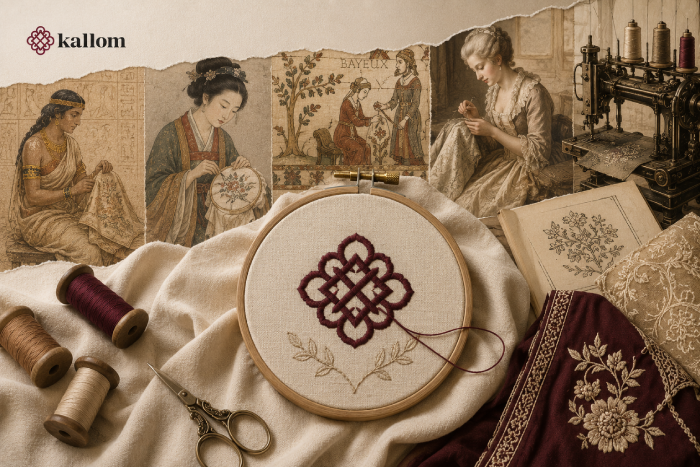
Embroidery isn't a modern invention far from it. Evidence of embroidered fabric dates back thousands of years, with early examples found in Chinese, Egyptian and Middle Eastern textiles. Throughout history, embroidery has been used to mark royalty, religious significance, military rank, and family heritage, from elaborately embroidered royal garments in medieval Europe to traditional folk embroidery passed down through generations in countries across Asia, Europe and the Middle East.
What's changed most isn't the technique itself, but the tools. Hand embroidery, once the only option, is now complemented by computerised machine embroidery allowing the same level of detail and durability, but at a scale that makes it accessible for everyday clothing rather than just ceremonial or luxury garments.
How Does Machine Embroidery Actually Work?
Machine embroidery starts long before the needle touches fabric. A design first has to be digitised converted into a stitch file that tells the machine exactly where to move, which stitch type to use, and when to switch thread colours. Once that file is ready, the fabric is hooped (stretched tight on a frame) to keep it stable, and the machine works through the design layer by layer, following the digitised path precisely.
This process makes machine embroidery ideal for consistent, repeatable results useful for team merchandise, uniforms, or any order where multiple identical pieces are needed. The trade-off is that it's bound by the digitising and hooping process itself, so highly detailed or one-off custom tweaks are less flexible than doing it by hand.
What Makes Hand Embroidery Different From Machine Work?
Hand embroidery relies entirely on a person guiding the needle stitch by stitch, without a pre-set digital file dictating the path. This makes it slower and less repeatable than machine embroidery, but it allows for a level of nuance and adjustment that a machine simply can't replicate a stitch can be adjusted mid-design based on how the fabric or thread is behaving in that exact moment.
The result often carries a slightly different texture and character compared to machine work, since no two hand-stitched pieces are ever produced in exactly the same way. It's typically better suited to smaller runs, fully custom designs, or pieces where the handmade quality itself is part of the appeal.
Popular Hand Embroidery Stitch Types You Should Know
Not every hand-stitched design uses the same technique, and knowing the basic stitch types makes it much easier to understand why one piece looks smooth and glossy while another has a raised, textured feel. Each stitch type has its own strengths, and skilled embroiderers often combine several within a single design to get the right balance of detail, durability, and finish. A handful of stitch types come up again and again in hand embroidery, each suited to different effects:
- Satin stitch — long, smooth stitches used for filling shapes or lettering with a glossy finish
- Backstitch — simple, versatile stitches often used for outlines and fine detail
- Chain stitch — looped stitches that create a textured, rope-like line
- French knots — small, raised knots used for dotted detail or texture
- Cross stitch — X-shaped stitches typically used in patterned, counted designs
Knowing these basics makes it easier to understand why a design looks the way it does, and why certain stitch choices hold up better than others over time.
How Embroidery Is Made on Clothing: Step by Step
If you've ever wondered how a logo or name actually ends up perfectly stitched onto a hoodie, here's what happens behind the scenes.
Design creation. Everything starts with the design a logo, a name, initials, or custom artwork. This can be an existing design a customer provides, or something created from scratch.
Digitising the design. For machine embroidery, the design has to be converted into a digital stitch file using specialist embroidery software. This process, called digitising, maps out exactly where each stitch will go, what type of stitch will be used, and in what order essentially translating a flat image into a set of instructions an embroidery machine can follow.
Choosing fabric and thread. Not every fabric behaves the same way under a needle. Thicker fabrics like cotton-blend hoodies hold stitching well, while lighter fabrics may need a stabiliser backing to stop the material puckering or distorting during stitching. Thread choice matters too colour, thickness and finish all affect the final look and durability.
Hooping the fabric. The garment is secured tightly into an embroidery hoop or frame. This keeps the fabric taut and perfectly positioned, which is essential for stitch accuracy even a small amount of movement can throw off an entire design.
Stitching the design. The embroidery machine (or, for hand embroidery, the embroiderer) then stitches the digitised design directly onto the fabric, layer by layer, colour by colour. Machine embroidery typically works through the design using a sequence of thread colour changes, building up the full image stitch by stitch until it's complete.
Trimming and finishing. Once stitching is complete, any loose threads are trimmed, backing/stabiliser is removed, and the garment is inspected for quality checking stitch density, alignment and thread tension before it's considered finished.
Final quality check. A well-embroidered piece should sit flat, with no puckering, consistent stitch density, and clean edges around the design. This final check is what separates a professional embroidery finish from something that looks rushed or poorly executed.
This is the exact process behind every Custom Embroidered Sweatshirt we make.
What Is the Difference Between Embroidery and Printing?
This is one of the most common questions people have once they understand what is embroidery work and start comparing it to printed clothing. The two methods look similar from a distance but behave very differently up close and over time.
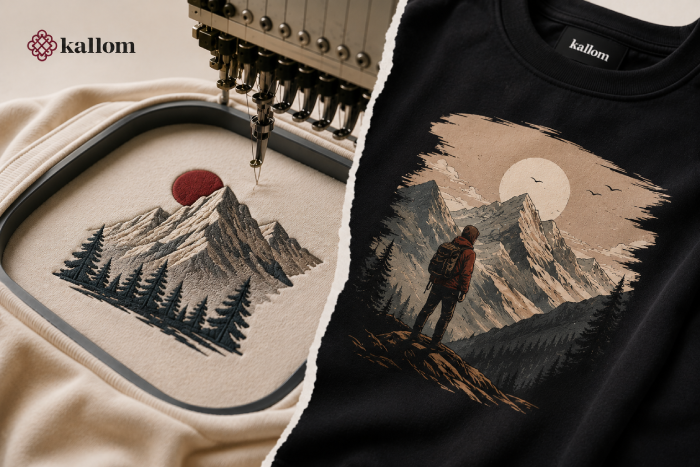
Printing applies ink or vinyl transfer on top of the fabric surface. It's usually cheaper and faster, and works well for large, flat, highly detailed or multi-colour designs. However, printed designs sit on the surface, which means they're more prone to cracking, peeling and fading with repeated washing and wear.
Embroidery, by contrast, stitches thread directly into the fabric structure. It has physical texture you can feel, holds its colour and shape far longer, and generally looks and feels more premium. The trade-off is that very fine gradients or photographic detail are harder to replicate in thread than in print embroidery suits bold logos, text and clean designs better than complex, highly detailed artwork.
For anything meant to be worn regularly workwear, everyday hoodies, uniforms embroidery tends to outperform printing on durability alone. Still deciding? Embroidery vs Printing see which suits you.
Is Embroidery Good for Hoodies?
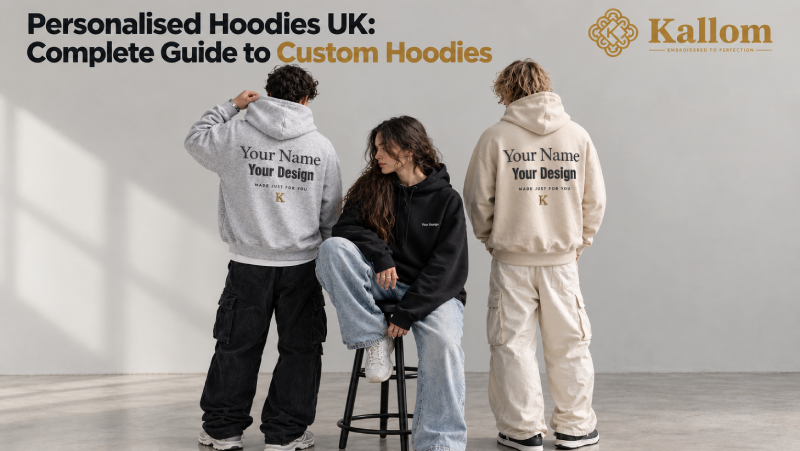
Yes - hoodies are actually one of the best garments for embroidery. The fabric is typically a thicker cotton or cotton-poly blend, which holds stitching well and gives the embroidery machine a stable surface to work with, resulting in crisp, clean detail.
Beyond the practical side, embroidery suits the way hoodies are worn. They're washed often, worn for long stretches, and layered under jackets all situations where a printed logo would show wear far sooner. An embroidered logo or name on a hoodie holds up through daily use in a way print simply doesn't, which is part of why embroidered hoodies have become the go-to choice for personalised and branded workwear. If you'd like to see the finish for yourself, See Premium Embroidery Hoodies from our current range.
Is Embroidery Good for Sweatshirts?
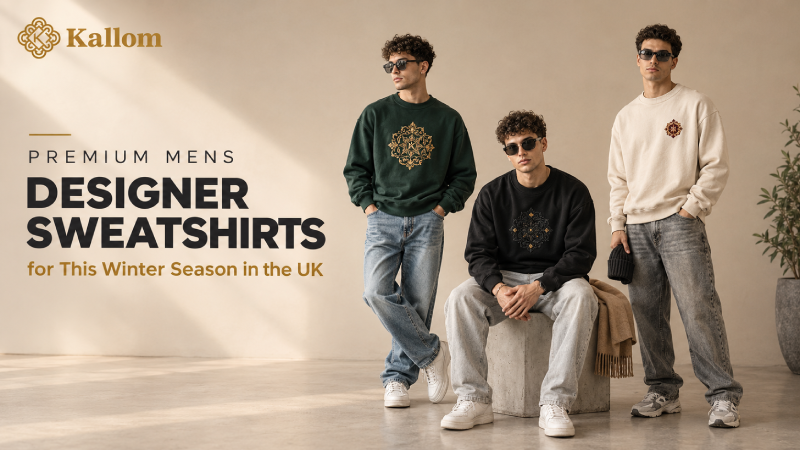
Much like hoodies, sweatshirts are excellent candidates for embroidery. Their fabric weight and structure give embroidery a solid base to sit on, and the flat chest or sleeve area provides plenty of clean space for a logo, name, or design.
Sweatshirts also tend to be worn across a wide range of settings casual, work, gifting and embroidery adapts well to all of them. A subtle embroidered monogram feels personal for a gift, while a full embroidered logo across the chest works just as well for team or company wear. As with hoodies, the durability of embroidery means a sweatshirt keeps its finished, considered look wash after wash, rather than fading into something that looks tired after a season. Take a look through our Shop Embroidered Sweatshirts if you'd like something made the same way.
Common Types of Embroidery Stitches
- Satin stitch – smooth, glossy coverage, commonly used for lettering and logos
- Fill stitch – used to cover larger areas of a design with texture and depth
- Running stitch – fine outlining stitch, often used for detail work
- Chain stitch – decorative looped stitch, traditionally done by hand
- Cross stitch – small X-shaped stitches, often used in traditional/folk embroidery
Most modern clothing embroidery logos, names, monograms relies primarily on satin and fill stitches for a clean, professional finish.
How Do You Choose the Right Embroidery Design?
Choosing a design comes down to a few practical questions. First, consider size and placement a small monogram on a cuff needs a very different design to a full logo across the chest of a hoodie. Second, think about colour count designs with fewer, bolder colours tend to embroider more cleanly than highly detailed, multi-tone artwork.
Text-based designs (names, initials, short phrases) generally translate beautifully into embroidery, as do simple logos with clear lines. If you're working from an existing logo or image, it's worth checking whether fine detail will need to be simplified slightly during digitising a good embroiderer will flag this before stitching begins, so the finished result looks sharp rather than muddled.
Finally, think about the garment itself. A dark hoodie needs enough colour contrast for the design to stand out; a lighter sweatshirt gives more flexibility with thread colour choice. Not sure where to start? Design Your Own Embroidery and we'll help you get it right.
How Should You Care for Embroidered Clothing?
A hoodie or sweatshirt that's earning its keep every day still needs a bit of care to keep the embroidery looking sharp:
- Machine washable a cold wash is recommended to protect both fabric and thread colour
- Avoid bleach entirely, as it can weaken and discolour thread
- Tumble dry on low, or air dry where possible, for the best long-term shape
- Iron on low heat, and avoid ironing directly over embroidered areas use a cloth barrier if ironing nearby
- Wash inside-out to protect the stitching and colour over time
Stick to this and embroidered clothing will comfortably outlast a season or two of regular wear, with the design still looking as crisp as day one.
Why Embroidery Still Matters on Modern Clothing
In a world of fast fashion and printed logos that crack and fade within months, embroidery has held its value precisely because it doesn't cut corners. It's more durable, it looks and feels more premium, and it turns a plain garment into something genuinely personalised whether that's your initials on a hoodie, a team logo on workwear, or a name stitched onto a gift.
That lasting quality is exactly why embroidery remains the preferred choice for anyone who wants clothing that still looks intentional after dozens of washes, not just on day one.
Why Choose Kallom for Personalised Embroidered Clothing?
That's exactly the craft behind every piece at Kallom. Every embroidered hoodie and sweatshirt is stitched to order, not mass-printed, using genuine Premium Embroidery Work rather than a cut-corner alternative which is why the detail actually lasts wash after wash. Whether you want your own initials, a name, or a full logo for your team or business, Kallom handles the entire process from design to finished stitch. Want to see more finished pieces first? Follow Kallom on Instagram for a closer look at our work.
If you've got something fully bespoke in mind, Get Your Logo Embroidered Today and we'll take care of the rest.
Final Thoughts
So, what is embroidery? In simple terms, embroidery is the process of creating designs on fabric using stitched thread. It can be used to add names, initials, dates, logos, words and decorative designs to clothing. From personalised hoodies and sweatshirts to team and business clothing, embroidery provides a distinctive way to customise garments.
If you want to move from simply learning about embroidery to creating your own personalised piece, you can explore Kallom's embroidered clothing collection.
Frequently Asked Questions
What is embroidery in simple terms?
Embroidery is the technique of decorating fabric by stitching thread directly into it using a needle, either by hand or machine, to create a design, pattern, or text.
What is the meaning of embroidery?
The word comes from the Old French "embroderie," meaning to embellish or decorate. It refers to the act of enhancing fabric through stitched decoration.
What is embroidery work? Embroidery work refers to the overall craft and process of creating stitched designs on fabric from digitising and hooping through to the final stitching and finishing of a garment.
Is embroidery done by hand or machine?
Both. Hand embroidery is the traditional method, still used for intricate or artisanal work. Machine embroidery uses a digitised design and computerised machine for speed, precision and consistency, and is the standard method for clothing branding today.
How long does embroidery last compared to printing?
Embroidery is generally far more durable than printing. Because the thread is stitched into the fabric rather than sitting on top of it, it resists cracking, peeling and fading through repeated washing.