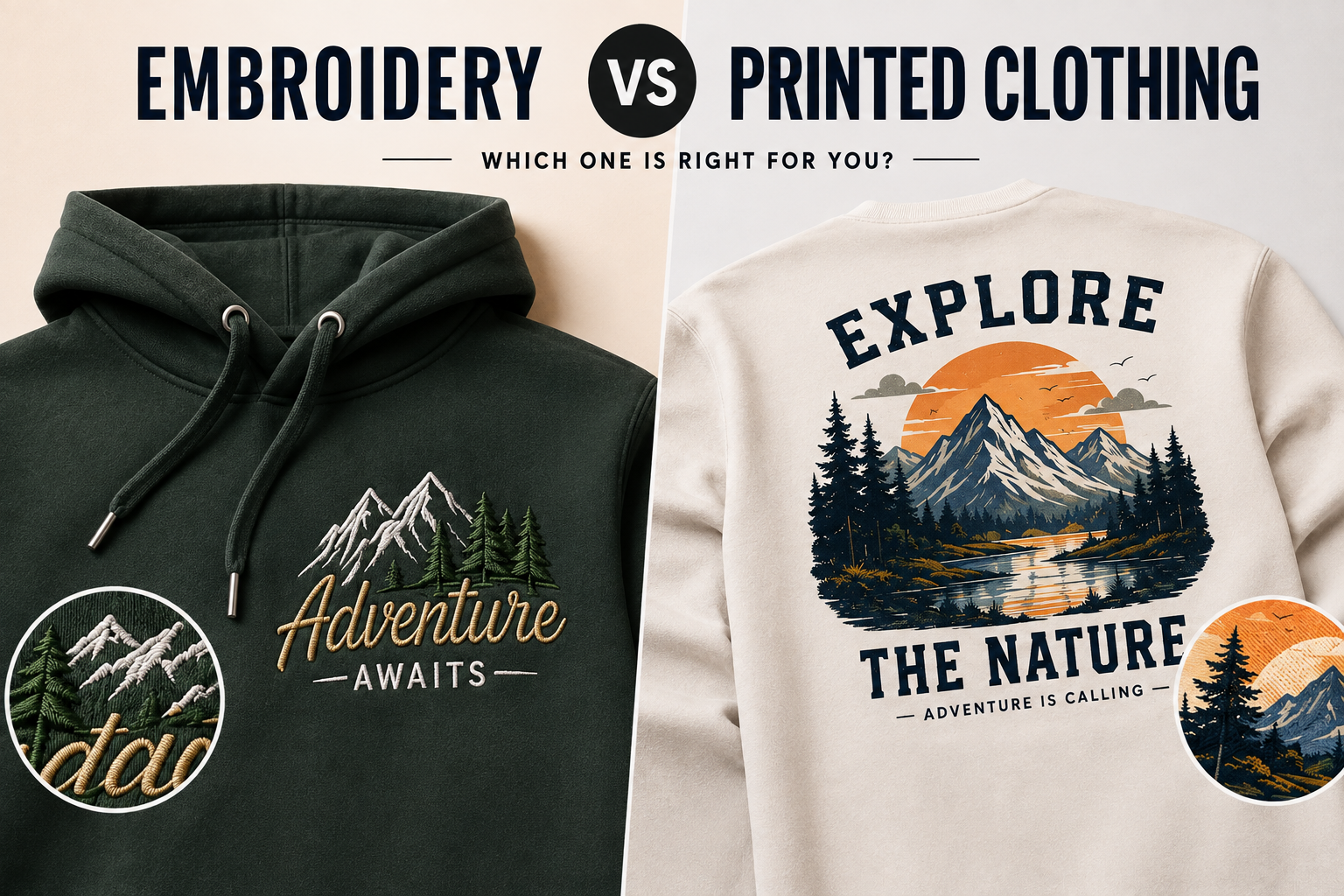
When it comes to custom clothing, one of the biggest decisions is choosing how your design should be applied to the garment. Embroidery and printing can both create eye-catching results, but they work in very different ways. Whether you're personalising a T-shirt, hoodie, sweatshirt, polo shirt, uniform or workwear, the right choice depends on your design, the type of garment, how often you'll wear it and the finish you want.
After more than 10 years working with streetwear fits and embroidery, I've seen how much the decoration method can change the final look and feel of a garment. In this guide, we'll compare embroidery and printing across appearance, durability, design detail, cost, comfort and everyday use, so you can choose the option that makes the most sense for your clothing.
What Is Embroidery?
Embroidery is the process of stitching a design directly onto fabric using thread. Instead of sitting on the surface like ink, the design is built into the garment through individual stitches. This creates a raised, textured finish that you can see and feel.
If you want to understand the process in more detail, our guide explains what embroidery is and how it works.
Embroidery is commonly used for:
- Company logos
- Names and initials
- Monograms
- School uniforms
- Sportswear
- Workwear
- Personalised hoodies
- Premium fashion clothing
One of the biggest reasons people choose embroidery and printing differently is the visual character they want. Embroidery has a tactile quality that immediately gives a garment a more premium and crafted appearance.
Advantages of Embroidery
Premium Appearance - Embroidered designs have depth and texture. Even a simple logo or set of initials can make a basic garment look more considered.
Excellent Durability - Good-quality embroidery is highly resistant to fading, peeling and cracking. With proper care, the stitching can remain intact for as long as the garment itself.
Professional Finish - Businesses, schools, sports clubs and organisations often choose embroidery for branded clothing because it creates a polished and professional appearance.
Great for Simple Designs - Names, initials, logos, symbols and short phrases generally work particularly well when stitched.
Things to Consider - Embroidery is not ideal for every type of artwork.
It can be less suitable for:
- Photographs
- Very fine gradients
- Extremely detailed illustrations
- Designs with many tiny colour changes
- Very large, highly complex graphics
It can also cost more than some printing methods because the design has to be digitised and stitched using thread.
What Is Printed Clothing?
Printed clothing uses ink, transfer materials or other printing techniques to place artwork onto the surface of a garment. Depending on the garment and design, methods can include screen printing, direct-to-garment (DTG) printing and heat transfer.
Printing is particularly useful for:
- Large graphics
- Illustrations
- Photographs
- Detailed artwork
- Colourful designs
- Event merchandise
- Promotional clothing
- Large front or back prints
When comparing embroidery and printing, one of the biggest advantages of print is the amount of visual detail it can reproduce. A photograph, gradient or complex illustration can contain hundreds of subtle colour and shading changes. Printing can reproduce these details much more easily than thread.
Advantages of Printing
More Design Freedom - Printing is well suited to detailed artwork, gradients, photographs and designs containing multiple colours.
Excellent for Large Graphics - Large front prints, back graphics and oversized artwork are generally easier to produce with printing.
Lightweight Finish - Modern printing techniques can create a relatively soft and lightweight finish, depending on the method and garment.
Cost-Effective for Certain Orders - Screen printing can be particularly economical for larger quantities, making it a popular option for events, teams and promotional clothing.
Things to Consider - Print durability depends heavily on the printing method, garment quality and how the clothing is washed.
Poor-quality prints may eventually:
- Fade
- Crack
- Peel
- Lose their sharpness
This doesn't mean printing is automatically less durable than embroidery. A high-quality print applied correctly to a good garment can last well, but the longevity can vary considerably between techniques.
Embroidery vs Printing: A Quick Comparison
Understanding the differences between embroidery and printing becomes much easier when you compare the main factors side by side.
| Feature | Embroidery | Printing |
| Appearance | Raised and textured | Smooth and vibrant |
| Durability | Excellent | Good to excellent, depending on method |
| Best for | Logos, names and simple designs | Artwork, photos and large graphics |
| Detail | Best for simpler artwork | Excellent for intricate designs |
| Large designs | Less suitable for very complex graphics | Ideal |
| Texture | Raised and tactile | Usually smooth |
| Colour detail | Limited by thread colours | Very flexible |
| Typical finish | Premium and crafted | Bold and graphic |
| Bulk orders | Can cost more depending on design | Often economical for large quantities |
There isn't a universal winner between embroidery and printing. The better option depends on what you want your finished garment to look like and how you plan to use it.
Which Is Better for Small Logos and Names?
If your design is a small logo, name, initial or short phrase, embroidery is usually an excellent choice. For customers looking for a ready-made personalised option, custom embroidered T-shirts are particularly suited to smaller logos, names and simple designs. The raised thread makes small, simple designs easy to notice without overwhelming the garment.
For example, a small embroidered logo on the chest of a polo shirt can create a professional appearance without needing a large graphic. Printing can also work for small designs, particularly when the artwork contains fine detail or multiple colours. The decision between embroidery and printing therefore comes down to the character you want from the finished design. Choose embroidery when you want texture and a premium stitched appearance; choose print when the artwork needs more visual complexity.
Which Is Better for Large Designs?
Large designs usually favour printing. A full back graphic, oversized illustration or detailed front artwork can contain too much information to reproduce efficiently through embroidery. Printing makes it easier to reproduce large areas of colour, fine lines, gradients and detailed artwork without adding substantial weight to the garment.
That makes printing particularly useful for fashion graphics, event T-shirts and designs where the artwork itself is the main focus. Embroidery can still be used for larger designs, but simpler shapes and fewer details usually produce the strongest result.
Which Method Is More Durable?
Durability is one of the most common reasons people compare embroidery and printing before ordering custom clothing. Embroidery has a strong advantage when the priority is long-term resistance to cracking, peeling and fading. Because the design is physically stitched into the garment, there is no printed surface layer that can crack or peel away.
Printing can also be highly durable, especially when the right technique is used on a good-quality garment. However, its performance depends more heavily on the printing process and garment care. If the clothing will be washed and worn frequently, embroidery is often the safer choice for simple designs. For occasional event clothing or detailed artwork, a quality print can still be an excellent option.
Which Is More Comfortable?
Comfort can depend on the garment, the design size and the application method. A small embroidered design can feel slightly raised because of the thread, while a printed design generally has a flatter finish. For a large embroidered graphic, the additional thread can also add weight and structure to the garment.
Printing is often preferable when you want a large design without adding significant texture. This is another reason why choosing between embroidery and printing should not be based on appearance alone. Think about how the garment will actually feel when you wear it.
Which One Costs More?
The price depends on several factors, including:
- Design size
- Number of colours
- Quantity ordered
- Garment type
- Artwork complexity
- Production method
- Setup or digitisation requirements
Embroidery can cost more for smaller orders because the design needs to be prepared for stitching and produced using thread. Printing can be more economical for large graphics and larger quantities, particularly when screen printing is suitable.
However, the cheapest option isn't necessarily the best value. If you're ordering workwear that will be washed frequently, a more durable embroidered logo may offer better long-term value than repeatedly replacing poor-quality printed garments.
Which Method Should You Choose?
The easiest way to decide between embroidery and printing is to start with the artwork rather than the price.
Choose Embroidery If You Want:
- A premium, textured finish
- A long-lasting design
- Names or initials
- Company logos
- Small chest designs
- School or sports clothing
- Workwear
- Personalised hoodies and sweatshirts
- A more understated appearance
Choose Printing If You Want:
- Large graphics
- Photographs
- Detailed illustrations
- Gradients
- Multiple colours
- Full-front designs
- Large back prints
- Event merchandise
- Promotional clothing
For seasonal inspiration, you can also explore these custom Halloween T-shirt design ideas if you're planning a personalised design for October. Think about the design first, then choose the method that allows the artwork to look its best.
Can You Combine Embroidery and Printing?
Absolutely. You don't always have to choose just one method. Combining embroidery and printing can create a more distinctive garment by giving each part of the design a different purpose.
For example, a hoodie could have:
- A small embroidered logo on the chest
- A large printed illustration on the back
- Embroidered initials on the sleeve
- A printed graphic across the front
This approach works particularly well when you want the premium texture of embroidery alongside the creative freedom of print. If you like the textured look on heavier garments, you can also explore how custom embroidered hoodies are being used to create more distinctive everyday streetwear.
For brands, teams and personalised clothing, combining both methods can also help create a visual hierarchy. A small embroidered logo can represent the identity of the wearer, while a larger printed graphic can communicate the main artwork.
Embroidery and Printing for Different Types of Clothing
The best method can also change depending on the garment.
T-Shirts - T-shirts are versatile enough for both methods. Printing is often ideal for large graphics and detailed artwork, while embroidery works well for smaller logos, names and minimal designs.
Hoodies and Sweatshirts - Hoodies and sweatshirts work particularly well with embroidery because the heavier fabric provides a strong base for stitching. Printing is also excellent for large back graphics and statement designs.
If you're looking for a relaxed everyday option, an oversized unisex hoodie can provide a suitable base for either a simple embroidered detail or a larger printed design.
Polo Shirts - Embroidery is a popular option for polo shirts, especially for businesses, clubs and workwear. - A small embroidered logo on the chest can look professional without making the garment feel overly branded.
Workwear - For workwear, durability and professional appearance are often more important than complex artwork.
This makes embroidery particularly suitable for company names and logos.
How to Care for Custom Clothing
Regardless of whether you choose embroidery and printing, proper garment care will help your clothing last longer.
Follow these basic steps:
- Turn garments inside out before washing.
- Use a cool or lukewarm wash.
- Avoid harsh bleach.
- Use a suitable detergent.
- Air dry where possible.
- Avoid unnecessary tumble drying.
- Iron inside out.
- Avoid direct heat over printed or embroidered areas.
Always follow the specific care instructions provided with your garment because different fabrics and decoration methods can have different requirements. Good care protects both the garment and the custom design.
Why Choose Kallom?
At Kallom, we focus on personalised clothing that feels more individual than mass-produced garments. Our approach combines customisation with attention to garment quality, fit and finishing. Whether you want a personalised name, initials, logo or custom artwork, the decoration method should be chosen according to the design and the way the garment will be worn.
For customers deciding between embroidery and printing, understanding the difference before ordering can make the process much easier. If you're considering printed clothing, our guide to custom printed tees in the UK can help you understand what to look for when choosing a printed garment. Kallom's focus on personalised clothing means the goal isn't simply
Conclusion
Choosing between embroidery and printing ultimately depends on your design, garment, budget and how you plan to wear it. If you want a premium, textured and durable finish for logos, names, initials or simple designs, embroidery is an excellent choice. If your design includes detailed artwork, photographs, gradients, multiple colours or large graphics, printing usually gives you more creative flexibility. You can also combine both methods when you want the best of both approaches. A small embroidered logo with a larger printed graphic, for example, can create a distinctive and balanced look.
The key is not to choose the method simply because it is cheaper or more popular. Choose the one that works best for your specific design and garment. When the right technique is matched with a quality garment, both embroidery and printing can create custom clothing that looks great and lasts.
FAQs
Is embroidery better than printing?
Neither method is automatically better. Embroidery is generally better for logos, names, initials and simple designs, while printing is more suitable for large graphics, photographs and detailed artwork. The right choice depends on your design and intended use.
Is embroidery more durable than printing?
Embroidery is generally very durable because the design is stitched into the fabric. However, high-quality printing can also last for a long time when the correct printing method, garment and care instructions are used.
Is embroidery more expensive than printing?
Embroidery can cost more for smaller orders because the design needs to be prepared for stitching and produced with thread. Printing can be more economical for large graphics and bulk orders, although the final price depends on the garment, design and production method.
Can you combine embroidery and printing on the same garment?
Yes. Combining embroidery and printing is a popular way to create more distinctive custom clothing. For example, you could have a small embroidered logo on the chest and a large printed graphic on the back.
Which is better for hoodies: embroidery or printing?
Both can work well on hoodies. Embroidery is particularly effective for smaller logos, initials and premium designs, while printing is usually better for large front or back graphics.
Which is better for T-shirts: embroidery or printing?
It depends on the design. Embroidery works well for small chest logos, names and minimal designs, while printing is better suited to large graphics, detailed artwork and colourful designs.
Does embroidery fade or peel?
Embroidery does not peel like a printed design because the artwork is made from thread stitched into the garment. With proper care, quality embroidery can remain intact for a long time.
Does printed clothing crack or peel?
Some printed designs can crack, fade or peel over time, particularly when lower-quality printing methods or poor garment care are involved. High-quality printing, combined with proper washing and drying, can significantly improve durability.
Which is better for a personalised hoodie?
For a personalised hoodie featuring a name, initials or small logo, embroidery can provide a premium and long-lasting finish. For a large or highly detailed graphic, printing may be the better option.
How should embroidered and printed clothing be washed?
Turn the garment inside out, use a cool or lukewarm wash, avoid harsh bleach and air dry where possible. If ironing is necessary, avoid applying direct heat to the embroidered or printed area.
Can embroidery and printing be used on the same design?
Yes. Different parts of one design can use different decoration methods. This can be useful when you want the texture of embroidery for one element and the colour or detail of printing for another.
How do I choose between embroidery and printing?
Start by looking at your design. For simple logos, names and premium textured finishes, embroidery is usually a strong option. For photographs, gradients, detailed artwork and large graphics, printing generally offers greater flexibility.